

How you use your warehouse directly impacts on your business’s overall profitability. If your inventory is disorganized or your vertical space is underutilized, you are likely leaving revenue on the table. You probably don’t need a bigger building. More likely, you simply need to maximize your existing space and prioritize efficiency. Here’s where strategic warehouse racking systems come into play. By implementing the right racking infrastructure, you can transform a cluttered floor into a high-density storage powerhouse. Learn more about how intentional warehouse racks can make a big difference for efficiency.
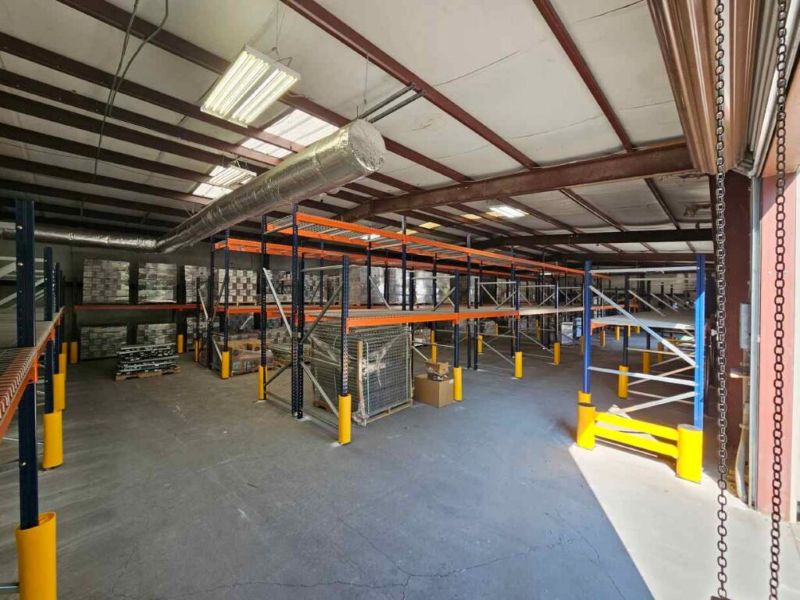
The Core Benefits of Warehouse Racking Systems
Introducing industrial warehouse racks into your facility brings a slew of benefits that could fundamentally change how your warehouse operates. Here are the primary ways these systems optimize your space:
Maximizing Vertical Space
Warehouse racks give you the ability to grow up, not out. Floor space is limited, but vertical space often goes wasted in basic storage setups. High-bay racking systems allow you to stack inventory safely to the ceiling, dramatically increasing your storage capacity without expanding your facility’s footprint.
Improving Inventory Accessibility
Accessibility is critical for maintaining a smooth workflow. The right warehouse racking system ensures that your picking team can access the necessary products without moving numerous other pallets out of the way first. Whether you need First-In, First-Out (FIFO) for perishable goods or Last-In, First-Out (LIFO) for non-perishable bulk items, specific racking configurations make inventory management much easier.
Enhancing Safety and Organization
A disorganized warehouse is a dangerous one. Cluttered aisles and unstable stacks of goods lead to accidents and damaged products. Racking systems provide a designated, secure spot for every pallet. This organization reduces the risk of collisions, falls, and product crush, ultimately protecting both your employees and your bottom line.
Popular Types of Warehouse Racking Systems
Every warehouse design is unique, and you may need a different racking system than the warehouse down the road. Learn more about some of the most popular options to determine which one makes the most sense for your specific storage challenges:
Selective Pallet Racking
This is the most common racking system found in warehouses today. With this setup, pallets are accessible from the aisle, meaning any pallet can be picked at any time without moving others. It’s often best for operations with high SKU counts and low turnover per SKU, or when 100% accessibility is required. While this approach to pallet warehouse racking offers the best accessibility, it also has the lowest storage density because it requires the most aisle space.
Drive-In and Drive-Through Racking
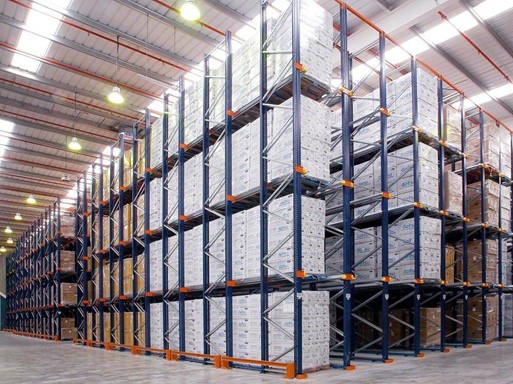
These systems are designed for high-density storage by eliminating aisles. Forklifts drive directly into the racking bays to place or retrieve pallets. Drive-in uses a single entry point (LIFO), while drive-through has entry points on both sides (FIFO). This approach is usually best for warehouses storing large quantities of the same product.
Push-Back Racking
Push-back racking is an excellent middle ground between density and selectivity. Pallets are placed on wheeled carts that rest on rails. When a new pallet is loaded, it pushes the previous one back. When the front pallet is removed, gravity gently moves the next pallet forward. This system utilizes vertical space and depth effectively, allowing for storage of multiple pallets deep.
Pallet Flow Racking
Pallet flow racking uses gravity to gently move pallets, which are loaded from the rear and flow down an inclined track of rollers toward the front. High-volume operations that require strict FIFO rotation often use this method, as it ensures automatic stock rotation and minimizes travel time for pickers.
Selecting the Right System for Your Facility
Your warehouse racks should be customized to your specific needs, and choosing the right system for your facility is a big decision. Fortunately, Bailey can help make your choice easier. Try these three steps to narrow down your options:
- Analyze product flow. If you move perishable goods, a FIFO system, such as pallet flow, helps prevent spoilage. If your goods are non-perishable and move in bulk, a drive-in system (LIFO) might offer better space utilization.
- Consider your SKU count and quantities. If you have thousands of different SKUs but only a few pallets of each, selective racking is your best bet because you need access to everything. Conversely, if you have 100 pallets of just five different products, high-density options are usually the better choice.
- Account for your forklift fleet. Not all equipment fits in all aisles. Drive-in racks require specific forklift dimensions, and very narrow aisle (VNA) racking systems require specialized equipment. Ensuring your material handling equipment is compatible with your racking is a critical, often overlooked step.
Warehouse Storage That Grows with You
As your business grows and your inventory profile changes, your storage needs will evolve. Over time, you’ll likely need to implement new warehouse racks to keep up with the demand. When it’s time to redesign your facility, Bailey is here to help. We work with businesses in Tennessee, Virginia, Kentucky, Georgia, and Washington state, helping them maximize efficiency through smart storage solutions. Contact us today.