

The Power of Work Assist Vehicles in Warehouse Management
Warehouse management is a constant balancing act. You are perpetually trying to maximize space, increase speed, and maintain stringent safety standards, all while keeping costs under control. For decades, the rolling ladder was the go-to tool for reaching high shelves or performing maintenance tasks. While cheap and simple, ladders have significant limitations regarding safety and efficiency. Modern work assist vehicles are the middle ground between simple ladders and heavy-duty industrial forklifts. Find out how this type of equipment helps streamline warehouse operations.

What Does a Work Assist Vehicle?
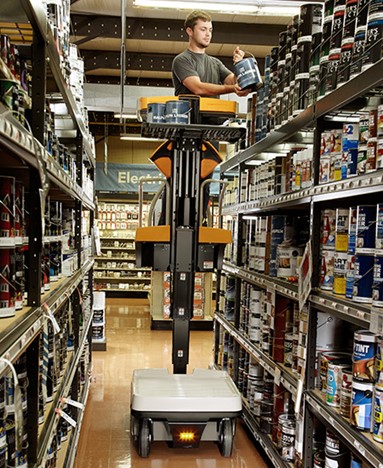
A work assist vehicle is a compact, powered machine designed to safely elevate an operator and a load. This might be for order picking, inventory management, or facility maintenance. Unlike a large reach truck or counterbalance forklift, a WAV is built for maneuverability in tight spaces and pedestrian-heavy areas. A prime example of this technology is the Crown Wave. These vehicles are engineered to handle everyday warehouse tasks that would otherwise require a ladder or a two-person team. They allow a single operator to travel and lift simultaneously, navigating narrow aisles with ease.
Safety Is the Driving Factor
Safety is the main reason why so many warehouses are adopting work assist vehicles. Falls from height remain one of the leading causes of workplace injuries, and traditional ladders can be unstable. Here’s how WAVs significantly lower this risk:
- Eliminating the Climbing Risk—WAVs entirely remove the need for workers to climb to unsafe heights. Instead, the operator steps onto a stable, enclosed platform and uses intuitive controls to reach the desired height. There is no balancing act, and the risk of slipping off a rung is eliminated.
- Reducing Physical Strain—Climbing up and down a ladder dozens of times a shift takes a toll on an employee’s knees and back. A fatigued worker is a slower worker and one more prone to making mistakes.
Enhanced Operational Efficiency and Speed
While safety is crucial, efficiency makes a big impact on your bottom line. In a high-volume warehouse, every second counts. Work assist vehicles provide a substantial speed advantage over manual methods and come with these specific advantages:
- Faster Travel Speeds—Walking a ladder from one end of a warehouse to another is slow and laborious, even if you have an excellent warehouse design. A powered work assist vehicle moves at roughly twice the speed of an average walking pace. Over the course of a day, this reduced travel time adds up to significant man-hours saved.
- Simultaneous Lift and Travel—Advanced models allow for simultaneous travel and lift functions. This means the operator can raise the platform while approaching the rack.
- Improved Pick Rates—For order picking, WAVs are invaluable. The operator has a dedicated tray or load deck to place items immediately—no need to climb up and down with the item in hand.
Versatile Applications Beyond Picking
While order picking is the most obvious use for work assist vehicles, their benefits extend far beyond moving boxes. They are true multi-purpose tools for warehouse optimization. Here are a few more ways WAVs simplify your process:
Inventory Control and Cycle Counting
Accuracy is vital in inventory management. Cycle counting often requires checking stock at high levels. Doing this with a ladder is tedious and can lead to “guesstimating” rather than accurate counting. With a WAV, the operator can quickly zip to the location, get on eye level with the stock, and verify counts.
Maintenance and Repair
Warehouses require constant upkeep. Light bulbs burn out, overhead doors jam, and signage needs updating. These maintenance tasks usually happen at height. Instead of setting up scaffolding or dragging out a scissor lift, a work assist vehicle provides a quick, safe platform for maintenance staff. They can carry their tools and parts on the load tray, reach the work area, and complete the job without obstructing aisle traffic.
Why Investing in Warehouse Optimization Pays
Investing in powered equipment is more expensive than buying a few ladders. However, you could get a return on your investment faster than you expect. Paying for WAVs once often leads to these reduced costs:
- Labor—Because these vehicles make tasks faster, you can often accomplish the same amount of work with fewer people.
- Injuries—Between workers’ compensation claims, lost time, potential legal fees, and the cost of hiring temporary replacements, a single serious fall can cost a company tens of thousands of dollars. By mitigating this risk, work assist vehicles help reduce the cost of workplace injuries.
- Product Damage—Carrying boxes down a ladder comes with a high risk of dropping and product damage. WAVs feature stable trays to hold inventory and reduce the occurrence of costly accidents.
Make Work Assist Vehicles Part of Your Operations
As supply chains become more complex and delivery windows shrink, the pressure on warehouse operations will only increase. Sticking to antiquated manual methods is a strategy with diminishing returns. Implementing work assist vehicles not only saves you time and money, but is a significant way to keep your employees safe. At Bailey, we work with businesses in Tennessee, Virginia, Kentucky, Georgia, and Washington state, offering them the gold standard in warehouse optimization equipment. Get in touch with us today to learn more about how work assist vehicles and other equipment can streamline your operations.