

How Goods-to-Person Robotics Transforms Retail and Warehouse Fulfillment
The modern consumer expects two-day delivery as a baseline, which creates a massive logistical pressure cooker for retail and consumer packaged goods leaders. Warehouses are running out of space, labor pools are shrinking, and the cost of errors are skyrocketing. To survive, fulfillment centers must evolve from static storage facilities into dynamic engines of commerce. The solution is Goods-to-Person (G2P) robotics. By fundamentally changing how products move through the warehouse, G2P systems are helping retailers double their throughput while cutting labor dependency in half.
For logistics leaders operating in Washington, Tennessee, and throughout the Mid-South, which is becoming the logistics buckle of the supply chain belt, understanding these automated solutions isn’t just about technology. It’s about capitalizing on a distinct geographic and economic advantage to dominate the North American market.
What Are Goods-to-Person Technology?
In a traditional person-to-goods warehouse, an operator spends a significant portion of their day walking up and down aisles, manually pushing a cart, and searching for products. Up to 60% of their time is spent walking rather than picking items. This process is not only physically exhausting for workers but also highly inefficient, slowing down overall productivity and limiting output.
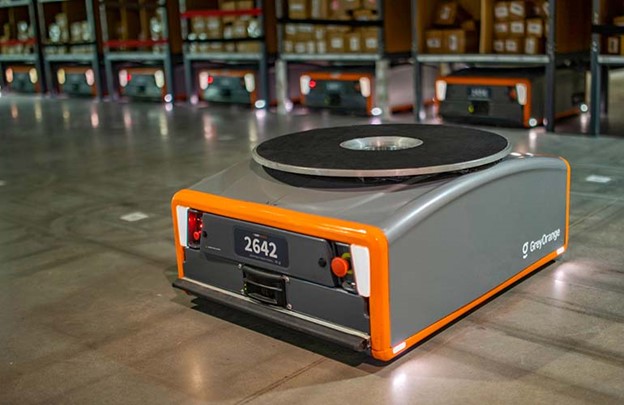
Goods-to-Person technology flips this model. Instead of the worker going to the product, robots bring the product to the worker. This can take different forms, such as small autonomous robots that carry entire shelves of inventory or high-speed shuttles that retrieve specific totes from a dense storage grid. The operator remains at an ergonomic station, and the inventory is brought to them.
By eliminating walking time, G2P technology drastically improves efficiency. Picking rates, which in traditional warehouses hover between 50-80 lines per hour, can skyrocket to 300-600 lines per hour. This leap in productivity is especially transformative for CPG solutions companies that manage high SKU counts and need to fulfill smaller, more frequent orders. The ability to process orders faster and with greater accuracy allows businesses to meet modern demands while keeping employees less fatigued and more focused on high-value tasks.
The Four Types of G2P Systems
Not all robots are created equal. Retailers must match the hardware to their specific SKU velocity and facility constraints. The market generally categorizes these intralogistics systems into four types:
1. Cube-Based Systems – Perhaps the most recognizable form of G2P, these systems feature robots driving on top of a massive aluminum grid and “dig” for bins stacked vertically. They’re best for achieving high storage density . The primary benefit is that they eliminate the “air” in the warehouse, offering the highest storage density per square foot.
2. Autonomous Mobile Robots (AMRs) – AMRs go beyond simple shelf-carrying robots and now include a broad range of goods-to-person and hybrid robotic systems. At the most basic level, shelf-carrying AMRs—like those popularized by Amazon Robotics—slide under a shelving unit, lift it, and transport it to a pick station. These systems excel in flexibility and rapid deployment. If additional throughput is needed during peak season, more robots can be added to the fleet without construction or major infrastructure changes. More advanced AMR systems, such as Exotec-style solutions, combine the flexibility of AMRs with elements traditionally found in shuttle systems. These robots travel freely across the warehouse floor, climb racking vertically, retrieve totes at speed, and deliver them directly to workstations. This approach offers higher throughput and faster access times than shelf-based AMRs while maintaining scalability and avoiding fixed aisle infrastructure. Overall, AMR-based systems are best for operations that value scalability, modular growth, and adaptability, making them ideal for evolving fulfillment environments, multi-SKU operations, and facilities with changing demand profiles.
3. Shuttle Systems (Aisle-Based) – Shuttles move at high speeds along tracks within racking to retrieve totes, delivering them to a lift that sends them to a conveyor loop connected to workstations. They’re best for extremely high throughput environments and offer the fastest retrieval times, but they require more complex, rigid infrastructure.
4. Module-Based Systems – These self-contained subsystems operate within a single aisle, using a dedicated robot for point-to-point retrieval. They’re best suited for replenishing high-velocity SKUs or managing kitting operations, offering the benefit of quick deployment in limited-space sites.
Overcoming the Labor and Accuracy Crisis
The labor shortage in logistics is the new reality. In Tennessee, Kentucky, and the rest of the Mid-South, where the automotive and manufacturing sectors compete for the same workforce as warehousing, finding reliable pickers is challenging.
Material handling experts know that G2P robotics alleviates this pressure by making the job easier and more productive. When you remove the heavy lifting and walking, the role becomes accessible to a broader demographic of workers. Additionally, training time drops from weeks to hours. An operator at a G2P station uses a pick-to-light system that illuminates exactly what item to grab and where to put it.
This leads to near-perfect accuracy. Manual picking inevitably leads to errors, such as grabbing the wrong size, color, or flavor. These errors are why effective CPG solutions are so critical, as mistakes result in costly returns and chargebacks for retailers. G2P systems can reduce this friction, ensuring that inventory data accurately reflects reality.
Goods-to-Person Robotics Software
Robots are only as smart as the software controlling them. The trend for 2025 and beyond is the integration of Artificial Intelligence into Warehouse Execution Systems (WES) that manage these fleets. Modern Goods-to-Person systems utilize advanced AI algorithms to analyze order data, enabling them to slot inventory efficiently. For example, if a particular brand or flavor of protein powder is selling especially fast this week, the system will recognize this pattern and proactively keep those bins near the top of the storage grid or at the front of the aisle.
For distributors, this self-optimizing capability means the warehouse becomes more efficient the longer it operates and the more data it processes. It also allows for sophisticated orchestration, where the software acts as a conductor, managing the complex flow of tasks between different types of automation. This creates a seamlessly integrated and fully autonomous workflow, from inventory storage to order fulfillment.
Don’t Get Left Behind. Adopt G2P Automation Today.
The convergence of the logistics infrastructure in states such as Tennessee, Virginia, Kentucky, Georgia, and Washington state with advanced G2P robotics creates a powerful opportunity for retail and consumer goods solutions companies. Bailey is no longer talking about experimental technology. These are proven systems that drive ROI by maximizing facility space, stabilizing the workforce, and guaranteeing order accuracy.
For business leaders, the question is no longer whether to automate, but how quickly can they adapt. Those who leverage G2P solutions will secure their place in the future of fulfillment, delivering reliability to their customers and profitability to their bottom line. For more information about G2P automation and how it can enhance your retail or warehouse solutions, contact us today.