

Reducing Safety Incidents with Guardrails, Automation, and Forklift Maintenance
Forklift and dock equipment safety is essential for compliance and efficiency. According to the Bureau of Labor Statistics, the transportation and warehousing sector ranks as one of the most dangerous job fields in the U.S.
The pressure to move freight quickly can often overshadow the need for caution, leading to devastating consequences. Improving safety in the loading dock requires more than just caution tape and training videos. It requires a strategic approach to dock equipment maintenance, physical safeguards, and the integration of modern technology. By investing in proper infrastructure and protocols, you can transform your loading dock from a liability into a safe, efficient asset that drives your business forward.
The High Cost of Cutting Corners
The average cost of a forklift fall-through incident, where a forklift drives off the edge of the dock or falls between the truck and the dock, is estimated at $191,000. This staggering figure includes medical costs for worker injury, equipment replacement, and building repairs.
However, financial loss is only part of the equation. The human cost is far higher. When a forklift falls from one level to another, the operator is more likely to die than if they were injured on level ground. These incidents often occur when the vibration of the forklift entering and exiting causes the trailer to slowly inch away from the dock, creating a deadly gap. Preventing these catastrophic events should be the top priority for any facility manager.
How to Secure the Trailer
One of the most effective ways to reduce safety incidents in warehouses is to physically secure the truck to the building. While wheel chocks are the traditional method, they leave significant room for human error. They can be placed incorrectly, removed too early, or ignored entirely by a rushed driver. More reliable solutions include:
- Trailer Lock Systems – These electric hydraulic systems install directly in front of the loading dock. They capture the trailer’s rear impact guard, securing it firmly in place. Unlike chocks, these systems often feature exterior traffic lights that signal to the truck driver when it’s safe to pull away and when they must stay put. This eliminates the miscommunication that often leads to drivers pulling away while a forklift is still inside.
- Trailer Stabilizing Jacks – Even when a trailer is stationary, it poses risks if not supported correctly. When a tractor disconnects from a trailer, the trailer can become nose-heavy or sink into soft asphalt. This instability can cause the trailer to tip over while forklifts are still inside working. High-strength steel stabilizing jacks prevent this by keeping the trailer level and secure, regardless of the ground conditions.
Preventing Falls with Guardrails and Gates
Slips, trips, and falls are among the most common causes of injury, and the ledge of a loading dock presents a constant fall hazard. OSHA has strict regulations regarding fall protection near exposed dock doors or openings, yet violations remain common. Here are some of the best ways to prevent falls:
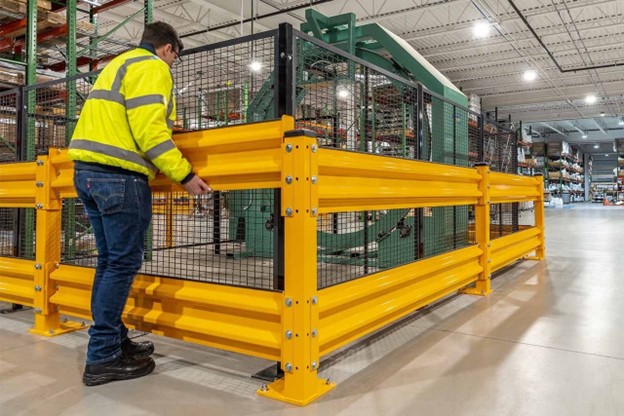
- Guardrails – Guardrails act as the first line of defense in high-traffic areas. By installing robust physical barriers, you physically prevent pedestrians and forklifts from accidentally rolling off the edge of an elevated platform. This is crucial in areas where visual distractions are high.
- Expand-A-Gates – For areas that need to remain accessible but occasionally closed off, interlocking collapsible barriers called Expand-A-Gates are an excellent solution. They can be quickly deployed to block off an unsafe area, such as a broken dock leveler or a spill, and just as easily folded away when normal operations resume.
Reducing Human Error with Automation
While physical barriers are essential, modern safety strategies are increasingly turning to warehouse safety automation to close the gap on human error. In a busy warehouse, relying solely on an employee’s memory or judgment can be a recipe for disaster. Automation in warehouse safety systems actively monitors and controls the environment to ensure optimal safety. For example, automated dock levelers can interface with trailer restraints, ensuring that the leveler can’t be operated until the trailer is securely locked in place. Similarly, forklift safety sensors can detect pedestrians or obstacles in blind spots, automatically slowing the vehicle down to prevent a collision.
These technologies streamline operations. An automated system works faster and more consistently than a manual one, reducing the time it takes to dock a truck and begin unloading. This efficiency gain is a key value proposition for logistics operations looking to maximize throughput without compromising worker welfare.
The Importance of Preventative Maintenance
Even the best safety equipment is useless if it doesn’t work when you need it. A broken dock lock or a malfunctioning leveler creates a false sense of security that can be more dangerous than having no equipment at all. Implementing a rigorous schedule for preventative maintenance for forklifts and dock equipment is non-negotiable. Regular inspections ensure that:
- Dock levelers transition smoothly without jarring the forklift operator, protecting their spine from repetitive shock injuries.
- Lights and communication systems are fully functional, ensuring clear visibility and signaling between drivers and dock workers.
- Hydraulics and mechanical parts are lubricated and free of wear, preventing sudden mechanical failures under heavy loads.
Building a Safer Future for Your Facility
Prioritizing forklift safety tips and loading dock safety isn’t just about avoiding OSHA fines or lowering insurance premiums. It’s about creating an environment where efficiency and well-being go hand in hand. By layering physical security measures, such as guardrails for warehouse safety and trailer locks, with intelligent warehouse safety automation, you can drastically reduce the potential for accidents in Tennessee, Virginia, Kentucky, Washington, and Georgia. The initial investment in these technologies pays dividends in reduced downtime, fewer equipment repairs, and, most importantly, a workforce that returns home safely every day. Contact us today for more warehouse safety tips and guidance on implementing these strategies in your facility.