

How Attachments & Lift Height Affect Forklift Load Capacity
Understanding how attachments and lift height impact forklift load capacity is essential for preventing accidents, equipment damage, and costly downtime. Many operators assume that if their forklift can lift 5,000 pounds under standard conditions, it can handle that weight regardless of attachments or how high they lift. That assumption leads to some of the most common forklift capacity errors and ranks among the top forklift downtime causes.
When you add an attachment or raise the forks to maximum height, the physics change dramatically. The center of gravity shifts, stability decreases, and the safe working load drops. Ignoring these factors doesn’t just violate forklift safety guidelines; it puts operators and everyone nearby at serious risk. Below, we’ll break down exactly how attachments and lift height affect capacity, explain the calculations you need to know, and outline the safety practices that keep your operation running smoothly.
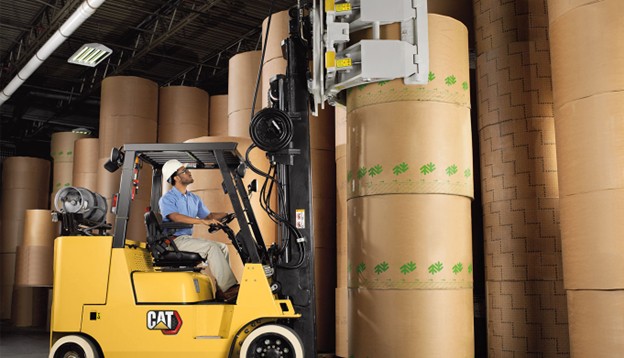
How Attachments Change Forklift Performance
Every forklift has a rated capacity based on its standard configuration: factory forks, no attachments, and a specific forklift load center (typically 24 inches). Add an attachment and everything changes. The attachment itself adds weight to the front of the forklift, shifting the center of gravity forward and reducing how much load the machine can safely carry.
Attachments also alter the load center. A side shifter, for example, moves the load further from the mast. Boom attachments extend even further. Each inch you move the load center away from the mast reduces the forklift’s effective capacity. That’s why forklift load capacity must be recalculated whenever you swap out forks for specialized equipment.
Beyond capacity reduction, attachments affect how the forklift handles. A rotator attachment changes the weight distribution dynamically as you turn loads. Lip sheet attachments require precise control since you’re pushing rather than lifting. These performance changes demand operator awareness and proper training, two factors that directly prevent forklift capacity errors.
Common Attachments and Their Effects
Different attachments serve different purposes, but all of them impact capacity in measurable ways. Here are some of the most common types and how they affect forklift performance:
- Side Shifters – These allow operators to move loads laterally without repositioning the entire forklift. They’re handy for tight spaces and precise placement. However, they add weight (typically 200-400 pounds) and extend the load center by several inches, reducing capacity by 5-10%.
- Fork Positioners – Fork positioners hydraulically adjust the distance between forks, eliminating manual adjustments. Like side shifters, they add weight and alter the load center, resulting in similar capacity reductions.
- Clamps – These are for handling items like drums, bales, or appliances. They’re heavier than forks and often push the load center further out, sometimes reducing capacity by 15-20%.
- Booms and Jibs – These extend the forklift’s reach for construction or maintenance tasks. Because they project the load far from the mast, they dramatically reduce capacity. These attachments also elevate loads, compounding the stability challenges.
- Rotators – Rotators enable loads to be tilted or rotated 360 degrees, useful for dumping or positioning awkward items. The rotating mechanism adds substantial weight and constantly changes load dynamics, requiring careful attention to capacity limits and operator skill.
Understanding Lift Height and Capacity Reduction
Even without attachments, lift height alone affects how much weight a forklift can safely handle. The higher you lift a load, the less stable the forklift becomes. Most forklifts experience capacity reductions at higher lift heights. A machine rated for 5,000 pounds at standard lift (around 10-12 feet) might only safely handle 4,000 pounds at maximum lift height. The exact reduction varies by forklift model, mast type, and whether it’s a reach truck, sit-down counterbalance, or narrow aisle forklift.
Free-lift masts offer an additional consideration. These masts allow the forks to raise initially without extending the outer mast sections, maintaining a lower overall height for clearance in trailers or low ceilings. Once the free-lift portion is exhausted and the outer mast extends, stability decreases further. Operators must know where free-lift ends and full extension begins.
Combining high lifts with attachments multiplies the risk. A rotator attachment at maximum lift height can reduce capacity by 40% or more compared to standard forks at low height. These are real-world conditions that cause tip-overs and serious injuries when operators fail to adjust for reduced capacity.
The Basics of Forklift Capacity Calculations
Manufacturers provide formulas and data plates, but understanding the basic math helps operators make informed decisions on the fly. Start with the forklift load center. Standard load centers are 24 inches, meaning the load’s center of gravity is 24 inches from the fork face. If your load’s center of gravity is further out, the capacity drops.
The formula is: Adjusted Capacity = (Rated Capacity × Rated Load Center) ÷ Actual Load Center.
For example, if your forklift is rated for 5,000 pounds at a 24-inch load center, and your load has a 36-inch center, Adjusted Capacity = (5,000 × 24) ÷ 36 = 3,333 pounds. That’s a significant reduction. Now add an attachment that moves the load center farther out, or add 300 pounds to the front, and the numbers drop even more.
Key Safety and Compliance Considerations
Preventing forklift capacity errors is mandated by OSHA and enforced through forklift safety guidelines. OSHA requires that operators be trained on the specific equipment they’ll use, including all attachments. It also mandates that load capacities not be exceeded and that operators understand how attachments and lift heights affect those capacities.
Compliance starts with proper data plates. Every forklift must have a legible capacity plate showing rated capacity, load center, and any adjustments for attachments. If a plate is missing or unreadable, the forklift should be taken out of service until it’s replaced. Operating without a capacity plate is a violation and a major forklift downtime cause when inspectors or auditors catch it.
Regular maintenance and inspections also play a role. Pre-shift checks should include verifying that the correct capacity plate is installed, checking for attachment damage, and ensuring that hydraulic systems function correctly. Any defects must be reported and corrected before the forklift returns to service.
Reduce Downtime With Proper Forklift Capacity Training
Understanding how attachments and lift height affect forklift load capacity is a daily responsibility. Every time an operator adds a side shifter, raises the mast to maximum height, or lifts a load with an off-center weight distribution, they’re changing the machine’s safe working limits. Miscalculations lead to tip-overs, damaged goods, injuries, and unplanned downtime.
Include capacity calculations in your standard operating procedure. Ensure every operator knows where to find capacity plates, how to read lift height charts, and when to ask for help. Bailey’s operator training program can help your operators understand how to properly manage every attachment in your fleet.
For more resources on forklift safety, OSHA compliance, and operator training, contact us today. We can tailor programs to your equipment and operations.